
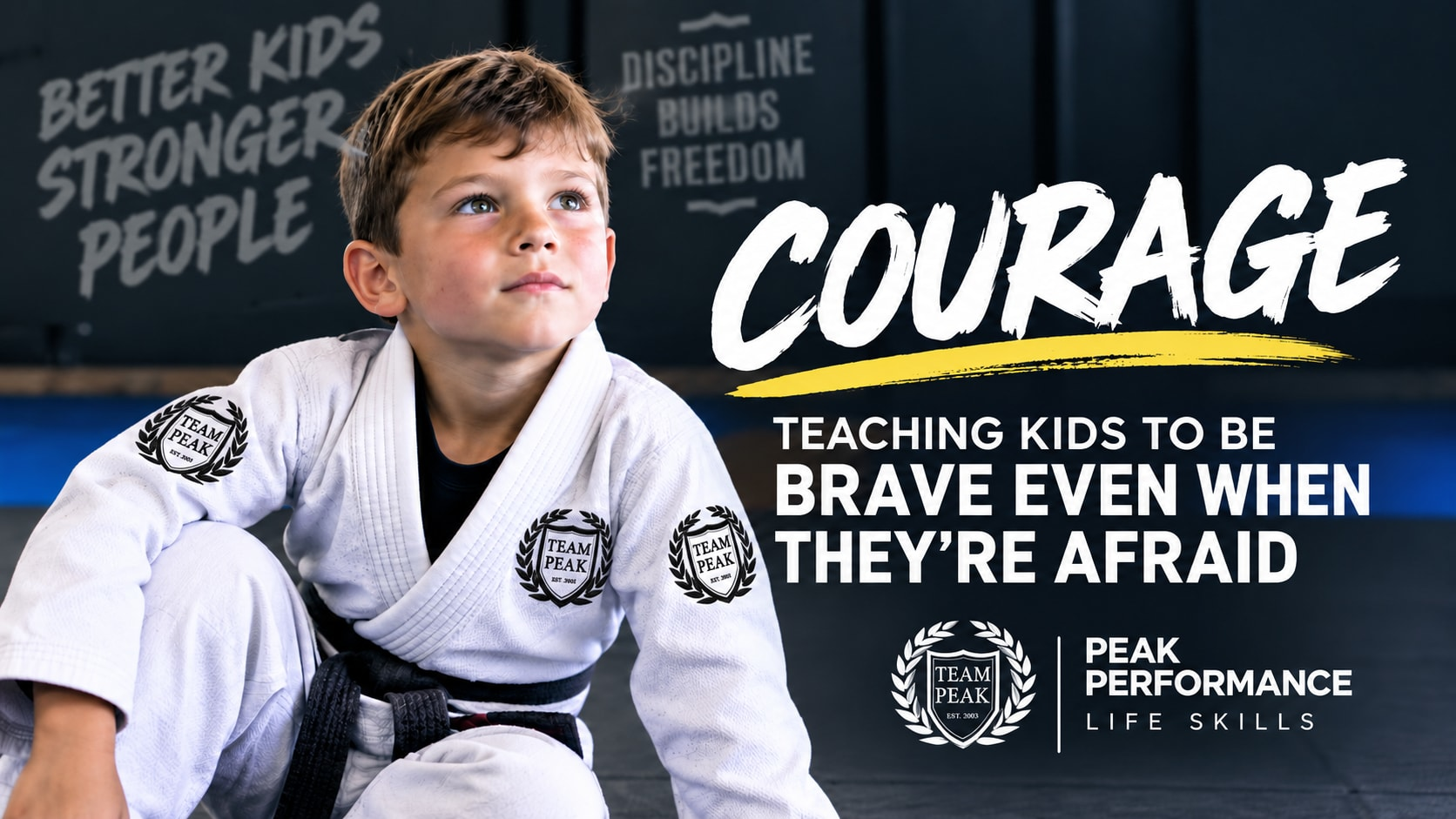
Courage: Learning to Be Brave Even When You're Afraid
Courage is often misunderstood.
We tend to think of courage as doing something big or heroic—standing up to a bully, facing a dangerous situation, or doing something that makes you look fearless.
But for kids, courage often looks much simpler.
Courage is raising your hand when you're not sure of the answer.
Courage is trying something new when you're afraid you might fail.
Courage is standing up for a friend.
Courage is admitting when you made a mistake.
Courage is walking into class for the first time, even when you're nervous.
Courage doesn't mean you aren't afraid.
Courage means you don't let fear make the decision for you.
Courage Isn't the Absence of Fear
One of the most important lessons we can teach children is that being scared doesn't mean they're weak.
Everyone gets nervous.
Everyone experiences uncertainty.
Everyone has moments when they don't know if they can do something.
The goal isn't to eliminate those feelings. Instead, we want to teach our kids how to move forward despite them.
A child who is nervous about trying a new technique but gives it a shot is showing courage.
A child who is afraid of making a mistake but keeps practicing is showing courage.
A child who feels uncomfortable speaking up when something isn't right but chooses to say something anyway is showing courage.
These moments may seem small to an adult, but they're opportunities for children to build a skill that will stay with them for the rest of their lives.
Martial Arts Gives Kids Opportunities to Practice Courage
One of the great things about martial arts is that kids don't just learn courage as an idea—they get to practice it.
Every class gives children opportunities to step outside their comfort zone.
Maybe they're learning a technique they've never done before.
Maybe they're working with a new training partner.
Maybe they're preparing for their first stripe, belt promotion, or tournament.
Maybe they're struggling with a technique that hasn't clicked yet.
There will be moments when they think:
"I can't do this."
That's where courage comes in.
Instead of giving up, they learn to take a breath, listen to their coach, try again, and keep moving forward.
Over time, these experiences teach children something incredibly valuable:
"I can do hard things."
Courage Also Means Doing the Right Thing
Courage isn't only about physical challenges.
Some of the most important acts of courage happen when nobody is watching.
It takes courage to tell the truth when you know you might get in trouble.
It takes courage to apologize when you've made a mistake.
It takes courage to include someone who is being left out.
It takes courage to walk away when friends are making a bad choice.
It takes courage to stand up for someone who can't stand up for themselves.
These are the moments that help shape a child's character.
We want our kids to understand that being courageous doesn't mean being the loudest, strongest, or toughest person in the room.
Sometimes, courage is simply choosing to do what you know is right.
How Parents Can Help Build Courage at Home
Parents play a huge role in helping children develop courage.
Here are a few simple ways you can encourage it at home:
1. Let Them Try
It's natural to want to protect our kids from frustration and failure.
But sometimes, the best thing we can do is give them the opportunity to try something difficult on their own.
Let them struggle a little.
Let them make mistakes.
Then remind them that struggling doesn't mean they can't do it.
2. Praise the Effort, Not Just the Outcome
Instead of focusing only on whether they succeeded, recognize the courage it took to try.
Try saying:
"I'm proud of you for trying even though you were nervous."
or
"You didn't give up when it got hard. That took courage."
This helps children understand that courage isn't measured by whether they win or succeed.
It's measured by whether they were willing to try.
3. Help Them Reframe Fear
When your child says, "I'm scared," don't automatically respond with, "There's nothing to be scared of."
Instead, try:
"It's okay to be nervous. Let's figure out what you can do next."
This teaches them that fear is something they can work through—not something that has to stop them.
4. Celebrate Small Acts of Courage
Courage doesn't always come in big moments.
Maybe your child finally spoke up in class.
Maybe they tried a new food.
Maybe they introduced themselves to someone new.
Maybe they admitted they were wrong.
Maybe they tried a difficult technique at martial arts.
Notice those moments.
When children learn to recognize their own courage, they're more likely to use it again.
Courage Builds Confidence
One of the biggest benefits of developing courage is that it creates confidence.
Not the kind of confidence that says, "I'm going to win every time."
The deeper kind of confidence that says:
"Even if I don't know what will happen, I know I can handle it."
That's a powerful lesson for a child to carry into school, friendships, sports, and eventually adulthood.
Every time a child faces something difficult and discovers that they can get through it, their confidence grows.
And that confidence becomes the foundation for their next challenge.
This Month at Peak Performance
At Peak Performance Martial Arts, we're focusing on Courage with our kids this month.
Our goal isn't to teach children to never be afraid.
It's to help them understand that fear, nervousness, and uncertainty don't have to stop them from moving forward.
Through martial arts, we get to create opportunities for kids to practice courage every week—to try, to fail, to get back up, to speak up, to help others, and to keep going when something gets difficult.
Because courage isn't something a child is simply born with.
Courage is a skill.
And just like any skill, it gets stronger with practice.
So this month, let's challenge our kids to do one thing that feels a little uncomfortable.
Try something new.
Speak up.
Help someone.
Try again.
Take the first step.
Because sometimes the bravest thing a child can say is:
"I'm scared… but I'm going to try anyway."
And that's where growth begins.